The project under the acronym The Makers (Mobilizing Arts, Knowledge and Education to Reclaim Human Agency. Strategies for the Age of Machine Thinking) has received funding of EUR 1,643,280 under the Marie Skłodowska-Curie Actions programme, which is part of Horizon Europe. The consortium is led by the University of Silesia, and the project is headed by Michał Krzykawski, Professor at the University of Silesia, Director of the Center for Critical Technology Studies, a member of the Institute of Philosophy, and Vice-President of our Foundation.
The Contributory Lab Foundation is a partner in this interdisciplinary project, which Michał Krzykawski describes as follows:
“As a team, we want to confront one of the key challenges of our time: preserving human agency in a world saturated with algorithms. I am referring here to algorithms that predict human choices and enable the manipulation of people on an unprecedented scale (as in the case of recommendation algorithms powering digital platforms), algorithms that perform certain cognitive tasks for us and take over some functions of language (as in the case of algorithms powering language models), as well as the combination of the two.”
At the theoretical level of The Makers, the key concept is dreamability. We use this term to describe the ability to project oneself beyond existing structures—both real and imagined. It is through dreaming that we are able to imagine the future while maintaining a sense that life is worth living and that what we do is meaningful. In the project’s framework, dreamability is presented as a crucial component of human agency. At the same time, dreaming and agency are understood here not so much in relation to individuals, but rather on a collective level, concerning organizations ranging from groups to institutions.
The multidisciplinary synthesis that the project team aims to develop seeks to achieve a better understanding of the nature of the constraints imposed on us by digital technologies—from cognitive and psychosocial constraints to environmental ones—as well as to formulate recommendations aimed at fostering technological maturity. This is why the practical, experimental dimension of the project is equally important. Our ambition is to demonstrate that dreaming is a vital cognitive faculty, and that dreamability can not only be articulated but also measured and implemented. This requires changing the criteria by which human cooperation is measured and developing a better understanding of what exactly we are measuring.
Research activities will be conducted across three interconnected fields: artistic creation, knowledge production, and thoughtfully grounded education. The implementation of the project between 2026 and 2030 includes cross-sectoral knowledge exchange between universities, cultural institutions, and non-governmental organizations from eleven countries: Poland, France, Slovenia, North Macedonia, Canada, Ukraine, Germany, Switzerland, Ecuador, the Czech Republic, and Slovakia. These are:
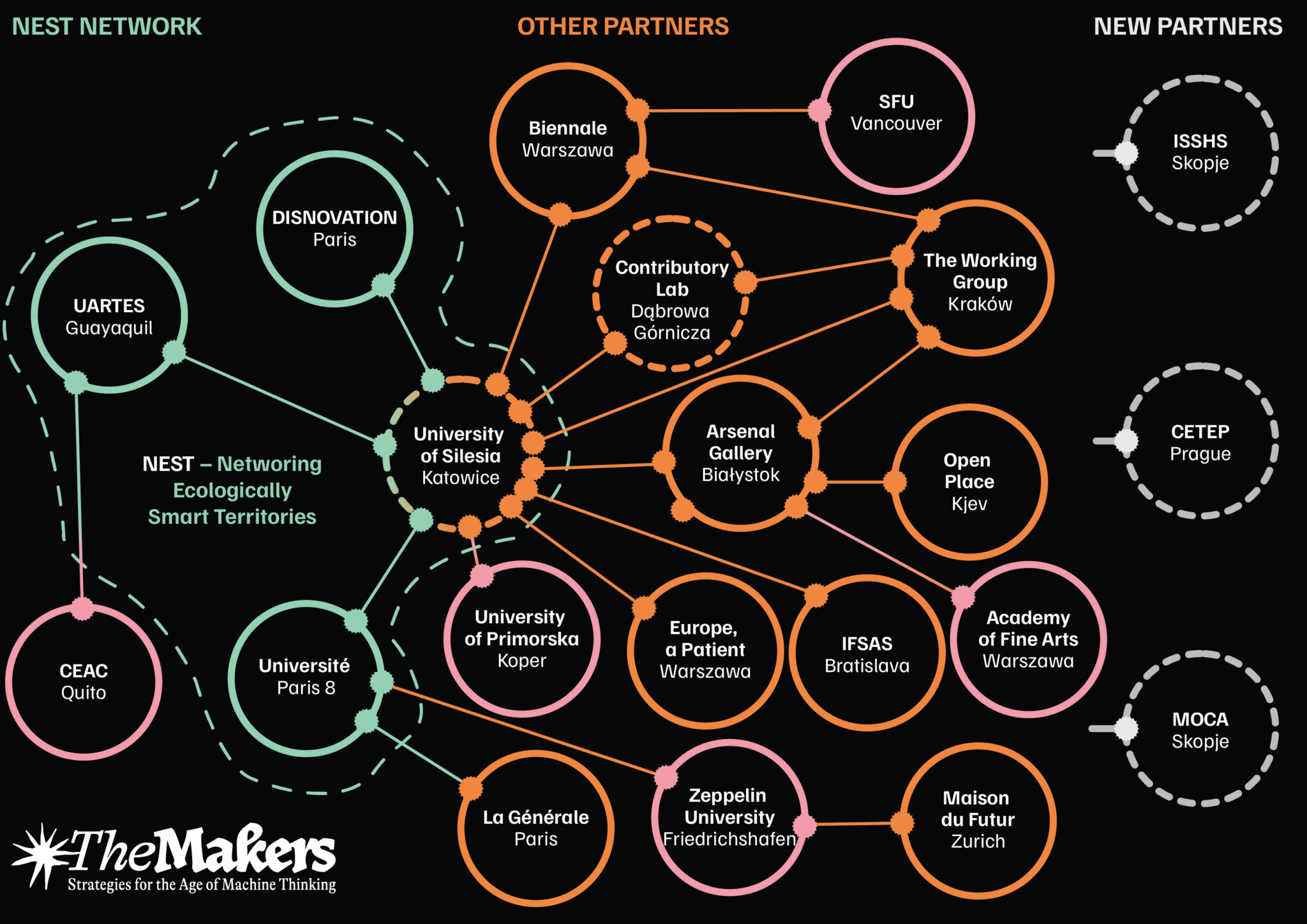
Graphic by: Katarzyna Janota
Academic partners: